







How to overcome your fear of the Spanish subjunctive
 24/09/2026
 By
Adrián Lago
By
Adrián Lago
The subjunctive is undoubtedly the part of Spanish that scares students the most. This is partly because, in languages such as English, it does not exist in quite the same way.
When a Spanish learner is able to master the use of the subjunctive, their level is clearly advanced. But don’t worry, we know that this can be difficult and that, when speaking, it is often hard to know whether or not we need to use the subjunctive.
What is the subjunctive?
In Spanish, tenses are grouped into three groups:
1.) Indicative: we use it to express facts that happen and are real in different time frames (present, past and future).
2.) Subjunctive: the subjunctive tenses are mainly used to express hypothetical ideas or concepts that have not happened, wishes and subjective opinions.
3.) Imperative: used to give advice, orders or instructions.
When is the subjunctive used?
Here, we have tried to bring together most of the uses of the subjunctive and present them in an infographic that is as simple and comprehensive as possible.
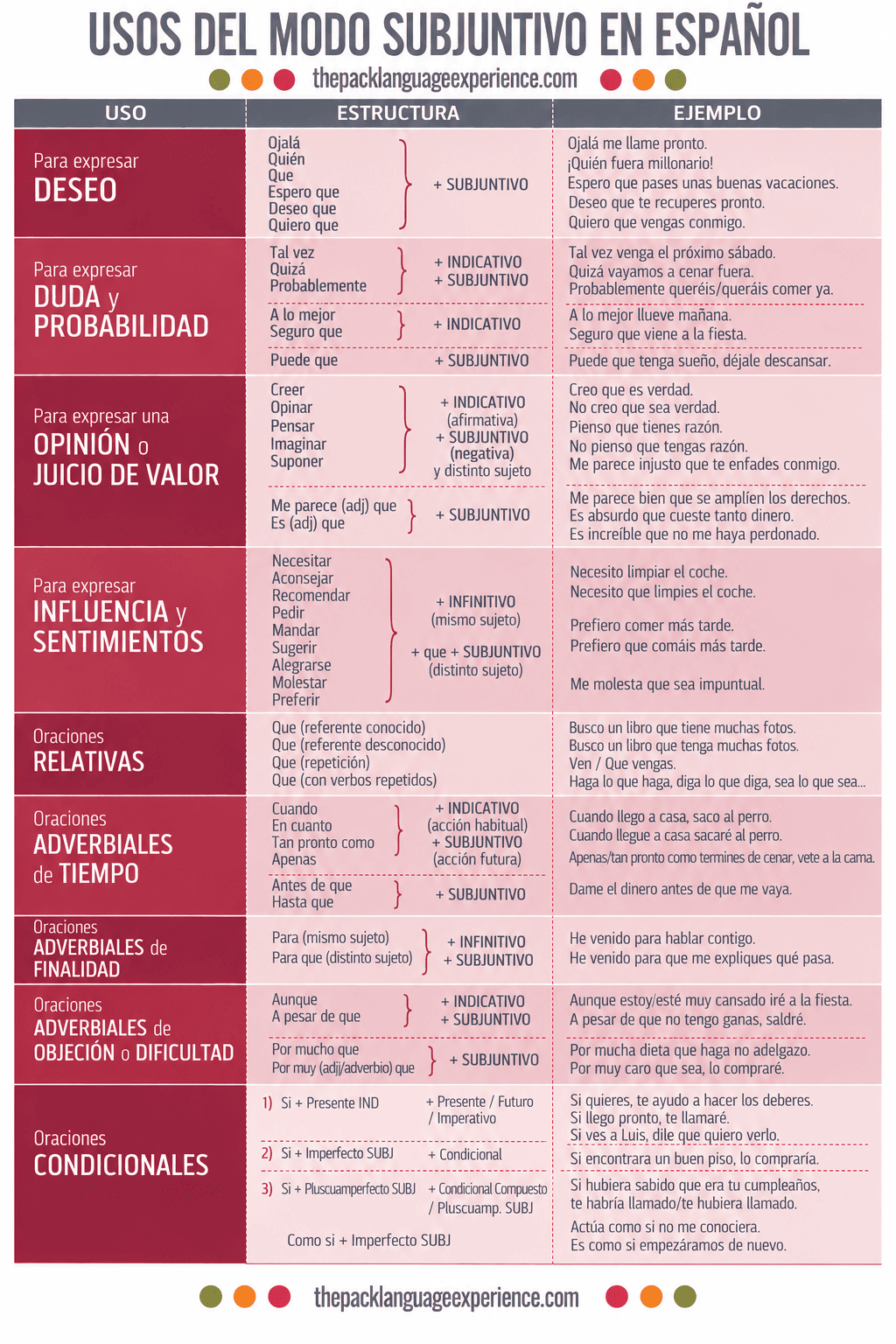
We hope this infographic helps you finally overcome your fear of the subjunctive and makes you feel more confident when expressing yourself in Spanish. Did you find it useful? Do you have any questions? Get in touch and let us know what you think. And if you’d like to put your Spanish into practice (subjunctive included!), join one of our Spanish language immersion trips in Spain. We look forward to seeing you!
(Header photo: Gerd Altman – Pixabay)
Author Info
